1997 - 2000 - 2003
We first came to Africa, to the remote south-west of Tanzania, because friends of the private AFRIKAHILFE SCHONDORF from Germany had taken my complete equipment for the training of technical drawers there in a container, including a large drawing board with an electronic drawing machine and asked me to teach the students there in technical drawing. And finally, in 1997 my wife Gertrud and I travelled for two months in September and October to faraway Africa.
Taken from the report of 1997:
"... The MTSS was established in a former road construction camp of the European company BENACO. The facilities had been abandoned by this company in 1992 and are now run-down. Some new buildings and enlargements are planned. By this time (October 1997) about 60 Students, male and female, aged between 15-21 attend the school and 14 of them are finishing the 4th form of the secondary school. The exams are planned for September 1997. ... The school day (Monday to Friday) starts at 5.15 with jogging through the dark school campus, lessons are from 7 to 16.20, interrupted by a short breakfast break and one hour lunchtime. The lessons are followed by extracurricular activities and individual learning which ends at 22.00 h. Including the headmaster, Mr. Sanga, the second master and an academic master, there are nine teachers working for the school. The teachers are young, about 25 years old, fluctuation is great. As far as the students are concerned it is the same situation, i.e. there is a constant change: Either they are not suitable or their parents don't have the money required. In spite of this fact it is said that a place at the school is very demanded. Many students come from the vicinity and the surrounding villages. ...There are some employees as well: a bookkeeper, a secretary, a gardener and even 3 soldiers, who do their military service by guarding the school entrance. ... The teachers are self-sufficient and the students help them. For all the students a very simple meal is prepared in a huge pot, a former tin barrel. ... In the morning there is a drink prepared of millet and soya; normally they drink water. ... (The water has to be fetched from a small stream which flows by a little lower.) Doing the washing is something the students have to do, besides this a lot of duties for the community has to be done. ...All the teachers and students always look very nice and clean. How they achieve this in spite of the permanent sand and dust caused by the strong wind is incomprehensible. In addition to this many things take place on the ground. ... In spite of the dust and the dried out ground flowers are planted and hedged along the buildings. The school atmosphere is friendly, in spite of a strict discipline and a strongly distinct hierarchy. ... It is a first rate pioneer achievement (as well of the Tanzanian Parents Association) to run a secondary school in this remote part of the country with almost no money! The headmasters and teachers, but all the students, too, are permanently busy, eager to learn and active under the most economical and simple conditions and in spite of this they are almost always good tempered. ..."
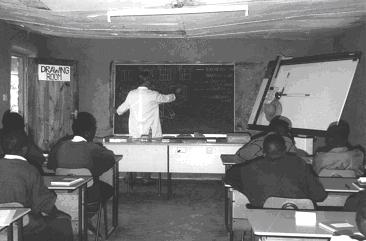
The next mission at the MTSS followed in September 2000 together with my friend Fritz Runge from Wiesbaden, again supported by the German AFRIKAHILFE SCHONDORF.
Taken from the report of 2000
"... The work programme (construction of a 4m long workbench from the drawing to the assembly, course in welding etc.) has been accomplished following our instructions and additionally the wanted PC-installations and instructions could be realized. ... Infrastructure and supply at the MTSS: The former water supply of BENACO has been restored, so that the housings have meanwhile water supply. ... Our meals were still cooked on the small charcoal stoves. ... (In the primitive school kitchen nothing has been changed.) Essential changes compared to 1997 are the fresh water supply (by a pipeline) from the nearby mountains ... and no longer from the little stream and some new buildings. There are also new electric power lines from the petrol generator to the users. The costs for the petrol exceed however the school budget by far. Therefor a constant supply with electric power is impossible. (Great hopes are set on a biogas system which is being constructed.)
Now we are in the year 2003
This time a refreshing of proceeding projects is in the programme. In its centre is an up-to date documentation of the MASIMBWE TECHNICAL SECONDARY SCHOOL with its wide range of offers. To achieve this, the German couple Antje and Helmut Klein and Udo Kühn`s grandson Dieter Geiger are at disposal. The necessary material, as far as it is not available from former deliveries, came already to Tanzania by air in spring 2003.
Written by Udo Kühn